The Tetanus Toxoid (TT) vaccine is given during your pregnancy to prevent tetanus to you as well as your baby. Antibodies formed in your body, after the vaccination, are passed on to your baby and protect her for a few months after birth. It also helps prevent premature delivery. .. In many countries such as the US, the Td or tetanus-diphtheria vaccine is recommended for pregnant women.
Showing posts with label Babies. Show all posts
Showing posts with label Babies. Show all posts
Sunday, September 18, 2011
TT or the Td vaccine during pregnancy?

Thursday, December 2, 2010
Why Babies need more tummy time
How do we know that the babies who miss out on tummy time are at a lasting as opposed to temporary disadvantage? Looking at data from thousands of people born in 1966 in Northern Finland, a research group led by Charlotte Ridgway at the Institute of Metabolic Sciences, Cambridge, has shown that a one-month delay in infant motor development had the same detrimental effect on how a 14-year-old performs in physical education class as a one-unit increase in the same child's body-mass index. Using the same Northern Finland cohort, Ridgway and her co-authors also mapped a one-to-one link between the age at which infants stand unaided in their first year—another critical prewalking milestone—and their muscle strength and endurance, as well as cardiovascular fitness, at age 31.
Another team of researchers, led by Graham Murray at the University of Cambridge, has been looking into how early motor lags could affect other parts of the brain, like the areas responsible for cognitive functions. Using Northern Finland data as well as stats from second group of Brits born in 1946, this group found that the sooner children passed their prewalking motor-development marks, the better the more-complicated areas of their brains performed in later life. Every month in advance of the group average that a child learned to stand on his or her own translated to a half an IQ point increase at age 8. By age 26, early motor developers had higher reading comprehension. And by the time they hit their 30s, they had achieved a higher level of education and scored better on executive-function tasks like categorization—how fast they could group objects of similar shape and color.
What's the best way to make sure that babies who sleep on their backs get their share of tummy time? Dr. John Graham, a pediatrician and director of the Dysmophology Program at Cedars Sinai Hospital in Los Angeles, suggests parents get started soon after they bring their babies home from the hospital. (The exceptions to the tummy-time rule, Graham notes, are babies with weak or stiff necks, an occasional side effect of birth.) With babies who are too young to support their own heads, parents can lie down and cradle them on their chest, introducing the stomach position in a comforting way. When infants get older and get the head-lifting thing down, regularly placing toys around their field of view encourages them to look around and stretch. It's pretty basic, really. And if babies cry because they're not used to the stomach position, stick with it for a bit anyway. The long-term benefit is worth the short-term fuss.
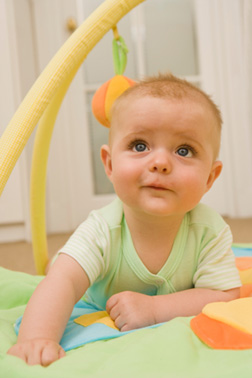
source;
Friday, July 16, 2010
The odds are against human babies!
Interesting article;
In the fable, the tortoise wins the race because the hare takes a nap. But, if anything, human infants nap even more than kittens! And unlike the noble tortoise, babies are helpless, and more to the point, hopeless. They could not learn the basic skills necessary to their independent survival even if they tried. How do human babies manage to turn things around in the end?
In a recent article in Current Directions in Psychological Science, Sharon Thompson-Schill, Michael Ramscar and Evangelia Chrysikou make the case that this very helplessness is what allows human babies to advance far beyond other animals. They propose that our delayed cortical development is precisely what enables us to acquire the cultural building blocks, such as language, that make up the foundations of human achievement. Indeed, the trio makes clear that our early vulnerability is an evolutionary “engineering trade-off,” much like the human larynx—which, while it facilitates the intricate productions of human speech, is actually quite a precarious adaptation for anyone trying to swallow safely. In the same way, they suggest, our ability to learn language comes at the price of an extended period of cognitive immaturity.
This claim hinges on a peculiar and unique feature of our cognitive architecture: the stunningly slow development of the prefrontal cortex (PFC). While other animals’ brain regions development in synchrony, in humans, the development of the PFC lags far behind that of other areas. The PFC is the swath of gray matter that makes up the anterior frontal lobes, and functionally, it appears to be heavily implicated in a wide-range of sophisticated planning and attention driven behaviors. Indeed, it is often referred to as the “control” center of the brain. One of its main functions appears to be that of selectively filtering information from the senses, allowing us to attend to specific actions, goals, or tasks. For this reason, “cognitive control” tasks are thought to be one of the best assessors of PFC function and maturity, and they are tests that young children reliably, and ignominiously, fail.
Subscribe to:
Posts (Atom)