Showing posts with label Health. Show all posts
Showing posts with label Health. Show all posts
Wednesday, November 9, 2011

Does Predictive Medicine have a future
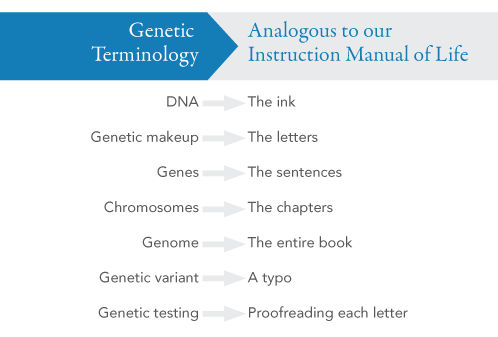
Brandon Colby, MD, is a world leader in the fields of genetic testing and predictive medicine. Dr. Colby will discuss the current and near-future technologies that are fueling the genetic revolution as well as the difference between genetic testing and genetic analysis. Specific focus will be applied to how genetic information is now being used by healthcare professionals to predict and prevent a large number of diseases such as heart disease, cancer, and even Alzheimer's. The talk will also include specific ways in-which you and your family can use the information contained within your genes to protect your health and wellness not in ten or five years, but today.
Like to hear commentary from Arnold Kling on the topic.
Like to hear commentary from Arnold Kling on the topic.
Friday, September 23, 2011
Marketing to Kids-free chocolates to paediatricians?
Marketers are devoting ever more effort to wooing children. The little monsters have a remarkable ability to nag their parents (whom marketers call “wallet-carriers”) into buying what they want. Better still, habits learned in childhood can last a lifetime. So companies bombard children with advertisements from the day they are born. The average American three-year-old can recognise 100 brands. Many can also recite annoying jingles more readily than their times tables. Given a choice between carrots and “McDonald’s carrots”, children hungrily choose the latter. From a company’s point of view, the earlier you hook your customers, the better. Experiments on rats suggest that a taste for junk food can be acquired in the womb.The most effective marketing tools are often subtle. Kopiko, a confectioner from the Philippines, distributes free chocolates to paediatricians. Apple offers baby-friendly apps such as “Toddler Teasers” and “Baby Fun!”. Gatorade, a drinks-maker, tweets good-luck messages to star athletes. A company called Girls Intelligence Agency employs 40,000 American girls to act as “guerrilla marketers”. It gives them free products and everything they need to organise a slumber party with their friends to try them out. Then it sits back and waits for the buzz to build.
See also Martin Lindstrom
Thursday, December 2, 2010
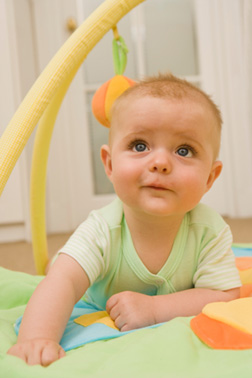
Why Babies need more tummy time
How do we know that the babies who miss out on tummy time are at a lasting as opposed to temporary disadvantage? Looking at data from thousands of people born in 1966 in Northern Finland, a research group led by Charlotte Ridgway at the Institute of Metabolic Sciences, Cambridge, has shown that a one-month delay in infant motor development had the same detrimental effect on how a 14-year-old performs in physical education class as a one-unit increase in the same child's body-mass index. Using the same Northern Finland cohort, Ridgway and her co-authors also mapped a one-to-one link between the age at which infants stand unaided in their first year—another critical prewalking milestone—and their muscle strength and endurance, as well as cardiovascular fitness, at age 31.
Another team of researchers, led by Graham Murray at the University of Cambridge, has been looking into how early motor lags could affect other parts of the brain, like the areas responsible for cognitive functions. Using Northern Finland data as well as stats from second group of Brits born in 1946, this group found that the sooner children passed their prewalking motor-development marks, the better the more-complicated areas of their brains performed in later life. Every month in advance of the group average that a child learned to stand on his or her own translated to a half an IQ point increase at age 8. By age 26, early motor developers had higher reading comprehension. And by the time they hit their 30s, they had achieved a higher level of education and scored better on executive-function tasks like categorization—how fast they could group objects of similar shape and color.
What's the best way to make sure that babies who sleep on their backs get their share of tummy time? Dr. John Graham, a pediatrician and director of the Dysmophology Program at Cedars Sinai Hospital in Los Angeles, suggests parents get started soon after they bring their babies home from the hospital. (The exceptions to the tummy-time rule, Graham notes, are babies with weak or stiff necks, an occasional side effect of birth.) With babies who are too young to support their own heads, parents can lie down and cradle them on their chest, introducing the stomach position in a comforting way. When infants get older and get the head-lifting thing down, regularly placing toys around their field of view encourages them to look around and stretch. It's pretty basic, really. And if babies cry because they're not used to the stomach position, stick with it for a bit anyway. The long-term benefit is worth the short-term fuss.
source;
Saturday, July 10, 2010
Thursday, July 8, 2010
Please Help Avoid Misdiagnosing Development Disorders
It is estimated that one in six children suffer from developmental disorders, including mental retardation, autism spectrum disorders, learning disorders, attentional disorders, genetic disorders, sleep disorders. However, despite the fact that all these disorders originate in the brain, most of them are diagnosed solely by looking at behavioural symptoms without ever looking at the brain! That is, they are diagnosed behaviourally rather than neurologically. This often results in an incomplete or inaccurate diagnosis....
Almost 50% of the children previously diagnosed with autism are found to be suffering from some degree of brain seizure activity that is undetectable to the eye. In some cases, these seizures are the cause of the child's autism-like symptoms. In other cases, these seizures are not causal, but comorbid (coexistent) to autism and are exacerbating the child's symptoms. And in a few cases, the seizures are mild and possibly unrelated to, or a consequence of, the child's symptoms. In the cases where these seizures are the cause of the symptoms, once the seizures have been detected and treated, the level and speed of recovery in the children has been remarkable.
Learn more about the work of Dr. Aditi Shankardass
Sunday, June 20, 2010
Is it the device or the technique?

Those days are gone. Dr. Berger started complaining to Zimmer a while back that one of its artificial-knee models was failing prematurely, and he went public recently with a study that he says proves it. Zimmer told him that the problem was not the artificial knee, but his technique, and pointed to data overseas indicating that the knee was safe.-Surgeon vs. Knee Maker: Who’s Rejecting Whom?
Last year, Zimmer did not give Dr. Berger a new contract. The company says it routinely rotates consultants.
“I trained hundreds of doctors for them and made them tens of millions,” Dr. Berger said in interview here, in which he also lambasted Zimmer executives as dissembling, out-of-touch bureaucrats. “So was this just a coincidence? Maybe it was. Maybe it wasn’t.”...
Amid the booming use of artificial joints in the United States, the breakup between Dr. Berger and Zimmer highlights what experts say is a troubling situation for patients and doctors: when disputes arise about orthopedic implant safety, there are no independent referees or sources of information because no one tracks the performance of the devices.
“There is no way of knowing who is right because we don’t have the data,” said Dr. Kevin J. Bozic, a professor of orthopedic surgery at the University of California, San Francisco....
While producers of implanted heart devices have a voluntary system in which outside panels investigate problems, American makers of orthopedic devices do not. Many of the artificial joints that surgeons like Dr. Berger use, including the Zimmer knee at issue, are cleared under law by the Food and Drug Administration for sale without testing in patients. In addition, no one in the country tracks the long-term performance of artificial hips and knees, a $6.7 billion annual business that surged as baby boomers reached middle age....
As he tells it, his relationship with Zimmer frayed over a version of a widely used Zimmer knee, known as the NexGen. The model at issue, called the NexGen CR-Flex, is designed to provide a greater range of motion than the standard NexGen.
Most surgeons implant an artificial knee using a cement-like adhesive to bond the thigh bone to the portion of the device that bends. But some specialists, like Dr. Berger, try to avoid adhesives because the cement can break down and cause device failure. So Zimmer also sells an uncemented version of the CR-Flex that relies instead on the bone naturally fusing with the implant.
Wednesday, June 16, 2010
Eat Brown Rice
Just replacing a third of a serving of white rice with brown each day could reduce one’s risk of Type 2 diabetes by 16 percent, a statistical analysis showed. A serving is a cup of cooked rice.-Eating Brown Rice to Cut Diabetes Risk
The study, which used data from two Harvard nurses’ health studies and a separate study of health professionals, isn’t the first to point a finger at foods like white rice as a culprit in Type 2 diabetes. A 2007 study of Chinese women in Shanghai found that middle-aged women who ate large amounts of white rice and other refined carbohydrates were also at increased risk for diabetes compared to their peers who ate less....
But, Dr. Sun said, there were many possible explanations for why brown rice eaters are at lower risk for Type 2 diabetes. In addition to having a lower glycemic index than white rice, brown rice also contains important nutrients like magnesium that are stripped during the refining process; it also contains much more fiber. Earlier studies have found that having these nutrients in the diet protects against diabetes, Dr. Sun said.
Subscribe to:
Posts (Atom)