Sunday, September 18, 2011

Tuesday, September 6, 2011
Thank a Teacher today
-What Teacher Would You Like to Thank?Since it’s back-to-school season across the country, I wanted to celebrate a group that is often maligned: teachers. Like so many others, it was a teacher who changed the direction of my life, and to whom I’m forever indebted.
Wednesday, August 31, 2011

Saturday, August 27, 2011
Economics in Children's Books
Harry Potter is unabashedly the Magical World of Monopolies. Almost every significant economic good or service is provided by a single provider from banking to wands to books and, finally, to school. The only exception is the entrepreneurial entry by the Weasley brothers into an existing but clearly underserved market. One suspects had Voldemort gone after the monopoly businesses rather than the government he may have been more successful in his evil ways.
We highly recommend Joshua Gans book
More from NYT article referred by Gans;
Such common tropes irk Ms. Gubar, an avowed liberal. “In children’s literature,” she said, “there is often this offensive classism whereby the poor are virtuous and the rich are evil.”
Some children’s books teach young readers what happens when there is an underdeveloped market economy. Nicholas Bloom, an economist at Stanford University, said “Little House on the Prairie” showed his 8-year-old daughter and 6-year-old son how difficult life was in the absence of specialization. “For these guys, it was so tough,” Mr. Bloom said. “Pa built his own house, they grew their own food, they sewed their own clothes. You realize how easy it is to live now.”
Even advanced concepts, like organized labor, show up in children’s literature. Justin Wolfers, a professor at the Wharton School of the University of Pennsylvania, cited “Click, Clack, Moo: Cows That Type” by Doreen Cronin and Betsy Lewin, a book about cows that withhold milk from a farmer until he provides electric blankets. Mr. Wolfers read the book to his 1-year-old daughter, Matilda, during the Wisconsin protests against Gov. Scott Walker’s attack on union rights.
Mr. Wolfers said the book also illustrated economic efficiency. A duck, the liaison between the cows and the farmer, persuades the farmer to install a diving board in the pond. “That costs the farmer almost nothing but the ducks really value it,” Mr. Wolfers said. “The diving board is a public good.”
Sometimes, economists think that children’s books get things wrong. Dr. Seuss’s “The Lorax,” about the destruction of a forest by a greedy industrialist, “assumes that there is no economic system in place,” Mr. Conant said. In a modern capitalist economy, he said, the trees “would get very valuable as they got scarce, and the person with the property rights would harvest them at an economically reasonable rate.”
By and large, the economic lessons in children’s books lean left of center. “I think the writers are not particularly sympathetic to or don’t understand how a market works,” said Gary S. Becker, the Nobel laureate who teaches economics at the University of Chicago. “It’s not easy to convey that to a child. It’s not always easy to convey it to grown-ups.”
For the most part, the economic concepts conveyed in the books reflect values like generosity and equity rather than competition. Raymond Fisman, an economist at Columbia University, said his 3-year-old daughter’s favorite books teach the importance of sharing and gift-giving, values that might not lead to the greatest wealth in the real world. But, he added, “I doubt that 3 is the age where you start teaching people the brutal economic truths of grown-up commerce
Friday, August 26, 2011
Thursday, December 2, 2010
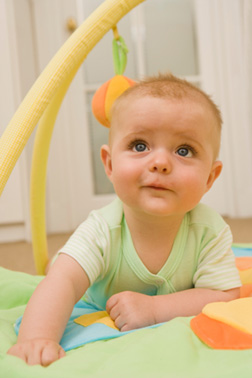
Why Babies need more tummy time
How do we know that the babies who miss out on tummy time are at a lasting as opposed to temporary disadvantage? Looking at data from thousands of people born in 1966 in Northern Finland, a research group led by Charlotte Ridgway at the Institute of Metabolic Sciences, Cambridge, has shown that a one-month delay in infant motor development had the same detrimental effect on how a 14-year-old performs in physical education class as a one-unit increase in the same child's body-mass index. Using the same Northern Finland cohort, Ridgway and her co-authors also mapped a one-to-one link between the age at which infants stand unaided in their first year—another critical prewalking milestone—and their muscle strength and endurance, as well as cardiovascular fitness, at age 31.
Another team of researchers, led by Graham Murray at the University of Cambridge, has been looking into how early motor lags could affect other parts of the brain, like the areas responsible for cognitive functions. Using Northern Finland data as well as stats from second group of Brits born in 1946, this group found that the sooner children passed their prewalking motor-development marks, the better the more-complicated areas of their brains performed in later life. Every month in advance of the group average that a child learned to stand on his or her own translated to a half an IQ point increase at age 8. By age 26, early motor developers had higher reading comprehension. And by the time they hit their 30s, they had achieved a higher level of education and scored better on executive-function tasks like categorization—how fast they could group objects of similar shape and color.
What's the best way to make sure that babies who sleep on their backs get their share of tummy time? Dr. John Graham, a pediatrician and director of the Dysmophology Program at Cedars Sinai Hospital in Los Angeles, suggests parents get started soon after they bring their babies home from the hospital. (The exceptions to the tummy-time rule, Graham notes, are babies with weak or stiff necks, an occasional side effect of birth.) With babies who are too young to support their own heads, parents can lie down and cradle them on their chest, introducing the stomach position in a comforting way. When infants get older and get the head-lifting thing down, regularly placing toys around their field of view encourages them to look around and stretch. It's pretty basic, really. And if babies cry because they're not used to the stomach position, stick with it for a bit anyway. The long-term benefit is worth the short-term fuss.
source;
Subscribe to:
Posts (Atom)